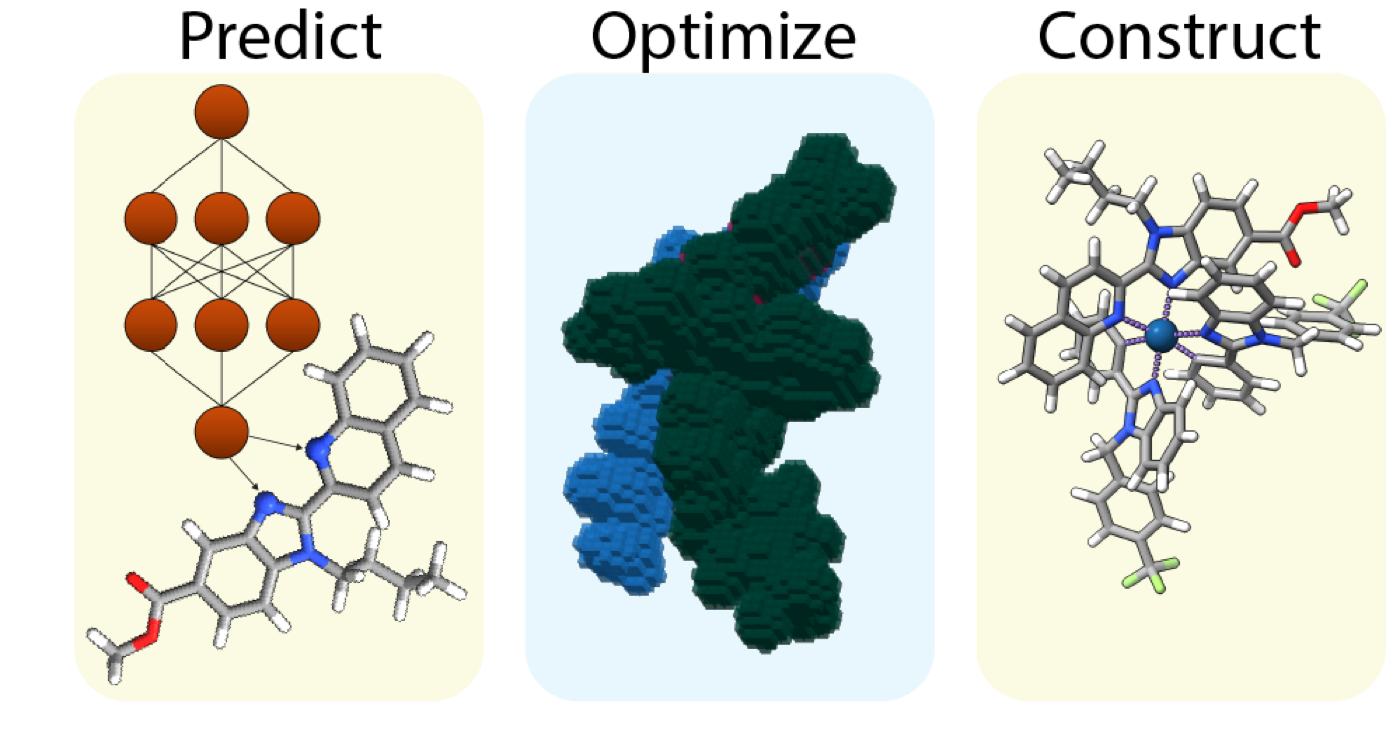
Computational modeling of transition metal complexes (TMCs) assumes knowledge of which atoms in a ligand bind to the metal. While trivial to determine for simple molecules from the spectrochemical series, organometallic bonding becomes challenging to predict for complex ligands. This limits researchers to relying on imperfect heuristics for assigning coordination, or restricting their investigations to simple molecules with known coordination.
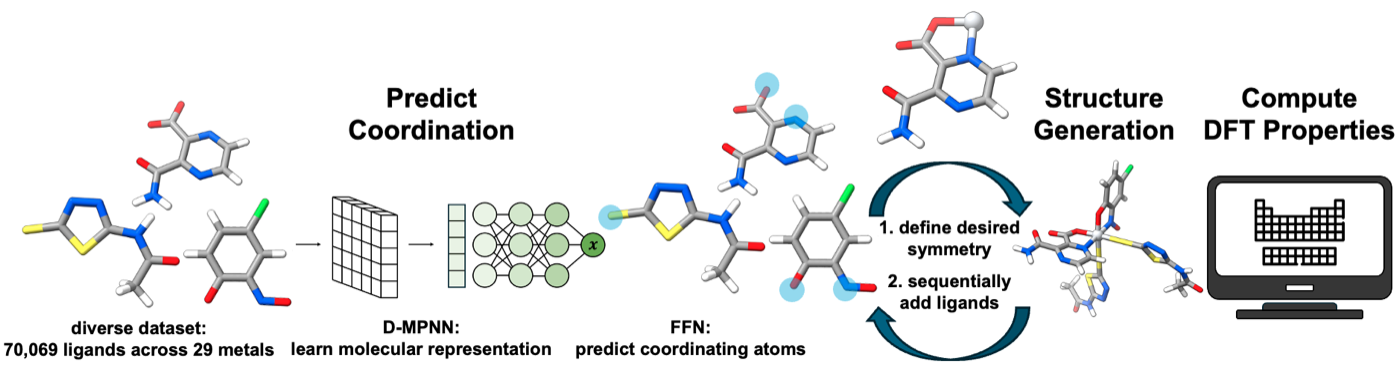
My work approaches this from a machine learning perspective. After curating a dataset of 70K unique ligands of experimentally-characterized coordination, I trained graph neural networks to predict metal–ligand coordination directly from ligand SMILES (PNAS 2025). Interpreting latent space reveals known trends in coordination chemistry, while integration with the structure-generation package molSimplify enables faithful reproduction of known 3D structures from predicted bonding patterns (JCIM 2026).
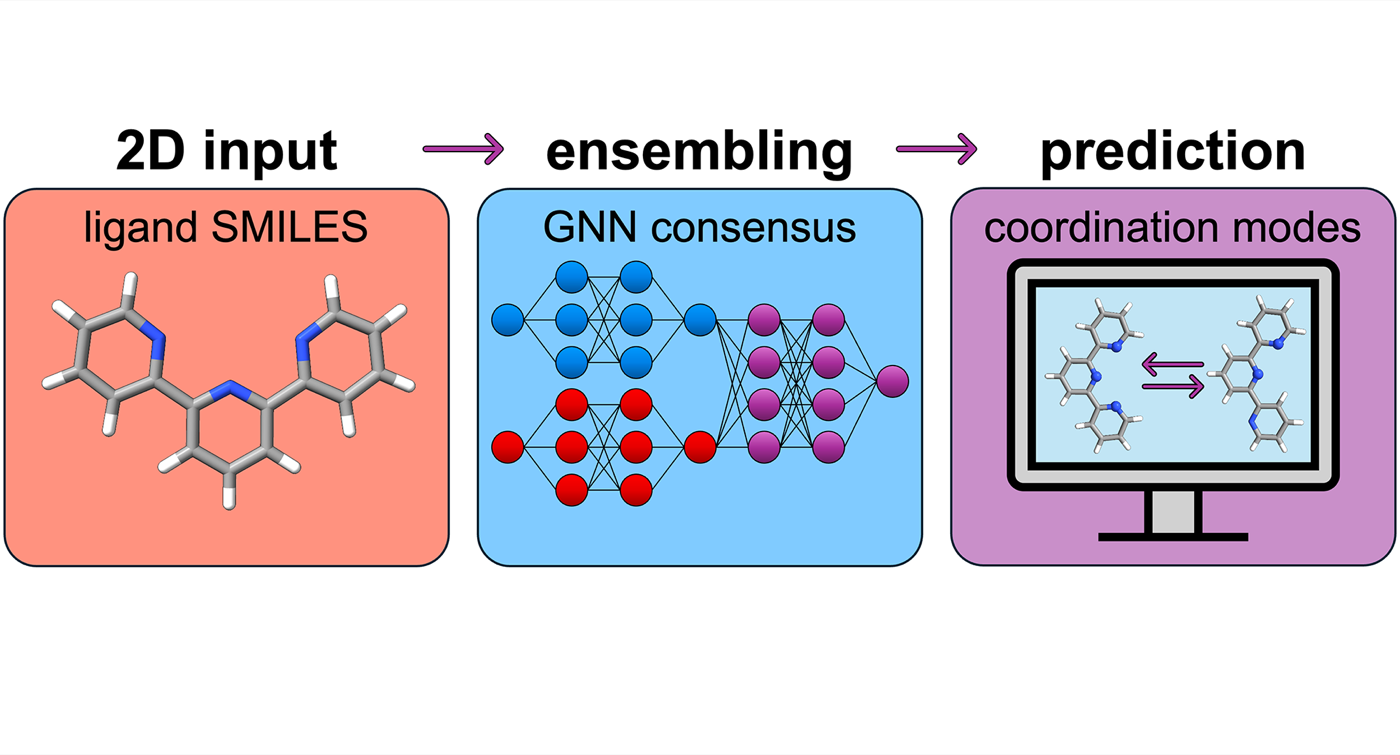
Real catalysts are more complicated, exhibiting dynamic, “hemilabile” bonding patterns along a reaction coordinate. To extend our methods to such chemically relevant systems, I curated datasets of known hemilabile ligands, fine-tuned a performant hemilabile classifier, and introduced an ensemble algorithm for predicting primary and alternative coordination modes validated with DFT (JACS 2025).
Each of these developments is available through the open-source pydentate software package, along with tutorials to facilitate their use among experimental and computational chemists alike.
molSimplify 2.0: Improved Structure Generation for Automating Discovery in Inorganic Molecular and Reticular Chemistry
Gianmarco G. Terrones, Roland G. St. Michel, Jacob W. Toney, Akash K. Ball, Yiran Wang, Aaron G. Garrison, Aditya Nandy, Ralf Meyer, Freya Edholm, Changhwan Oh, Sebastian G. Pujet, Daniel B. K. Chu, Davut Muhammetgulyyev, and Heather J. Kulik
Journal of Chemical Information and Modeling, 2026
We provide an overview of core molSimplify code functionality and recent updates that enhance its capabilities for automated molecular and materials modeling. We describe the mol3D and atom3D classes, which store atomic and bonding information for a wide range of functions, including reading, modifying, and characterizing molecular geometries from common file formats. Enhancements to decoration and substructure addition functions enable the systematic derivatization of template molecules. We introduce a new mol2D class that enables graph-based uniqueness checks and substructure identification. Most importantly, we introduce improvements to transition metal complex (TMC) generation that eliminate steric clashes and enable structure building with ligands of higher denticity. Integration with machine learning models that predict coordinating atom identities enables truly high-throughput, de novo TMC generation. We describe applications of molSimplify outside of isolated TMCs, including extensions to periodic systems (e.g., metal–organic frameworks) and to metalloenzymes through the protein3D class. We demonstrate our improved combined structure prediction and generation workflow by generating structures of a database of experimentally characterized Ir complexes from only the SMILES strings of their respective ligands. We envision that recent enhancements will make the code easily extendable to other periodic materials, such as covalent organic frameworks and zeolites, or to multimetallic TMCs.
@article{terrones2026jcim,title={molSimplify 2.0: Improved Structure Generation for Automating Discovery in Inorganic Molecular and Reticular Chemistry},author={Terrones, Gianmarco G. and St. Michel, Roland G. and Toney, Jacob W. and Ball, Akash K. and Wang, Yiran and Garrison, Aaron G. and Nandy, Aditya and Meyer, Ralf and Edholm, Freya and Oh, Changhwan and Pujet, Sebastian G. and Chu, Daniel B. K. and Muhammetgulyyev, Davut and Kulik, Heather J.},journal={Journal of Chemical Information and Modeling},year={2026},publisher={American Chemical Society},doi={10.1021/acs.jcim.5c02733},url={https://doi.org/10.1021/acs.jcim.5c02733},}
High-throughput virtual screening campaigns are invaluable for surveying the combinatorial space of possible transition metal complexes (TMCs), but they rely on accurate metal–ligand connectivity for meaningful results. Here, we curate a dataset of 70,069 unique ligands of known coordination from experimental structures of TMCs deposited in the Cambridge Structural Database. Using this dataset, we train separate graph neural network models to predict the total number and individual identities of ligand coordinating atoms with high accuracy and precision. Interpreting each model in terms of the learned molecular representations uncovers trends aligned with our understanding of coordination chemistry as well as chemical insights. Next, we integrate the trained models with the high-throughput screening software molSimplify and illustrate their utility by generating 1,175 TMCs and validating their geometries with density functional theory calculations. We anticipate these models will accelerate computational screening of TMCs with de novo combinations of metals and ligands in physically realistic coordination.
@article{toney2025pnas,title={Graph neural networks for predicting metal–ligand coordination of transition metal complexes},author={Toney, Jacob W. and St. Michel, Roland G. and Garrison, Aaron G. and Kevlishvili, Ilia and Kulik, Heather J.},journal={Proceedings of the National Academy of Sciences},volume={122},issue={41},pages={e2415658122},year={2025},publisher={National Academy of Sciences},doi={10.1073/pnas.2415658122},url={https://doi.org/10.1073/pnas.2415658122},}
Knowledge of how a ligand coordinates a metal is essential for mechanistic and data-driven studies of transition metal complexes (TMCs), but most analyses assume a single binding interaction for a given metal–ligand pair. In catalysis, many ligands engage in dynamic, hemilabile coordination modes, challenging this assumption. In this work, we curate data sets of hemilabile and nonhemilabile ligands from experimentally characterized structures in the Cambridge Structural Database, analyze trends in observed coordination modes, and introduce four exhaustive and mutually exclusive types of hemilability. Using these labeled data sets, we train graph neural networks to carry out classification of hemilabile ligands with high accuracy, precision, and recall and develop an ensemble algorithm that predicts primary and alternative chemically plausible coordination modes from SMILES strings in an end-to-end fashion. We demonstrate the utility of our algorithm by generating novel TMCs in predicted coordination modes and calculating the corresponding energy difference due to changes in coordination (i.e., ΔEc) with density functional theory. Comparing our novel TMCs in multiple poses against an energetic criterion from experimentally observed TMCs confirms the plausibility of our alternative poses. We anticipate that our open-source workflows will accelerate organometallic discovery in experimental and virtual screening campaigns by proposing realistic metal–ligand coordination.
@article{toney2025jacs,title={Identifying Dynamic Metal–Ligand Coordination Modes with Ensemble Learning},author={Toney, Jacob W. and St. Michel, Roland G. and Garrison, Aaron G. and Kevlishvili, Ilia and Kulik, Heather J.},journal={Journal of the American Chemical Society},volume={147},issue={52},pages={48218--48234},year={2025},publisher={American Chemical Society},doi={10.1021/jacs.5c17169},url={https://doi.org/10.1021/jacs.5c17169},}