property prediction, generative models, SOTA architectures, and uncertainty quantification built to handle the entire periodic table
Most molecular machine learning methods perform well on small organic molecules, but generalize poorly to organometallics, open-shell systems, and highly charged species. ElemeNet is my recently introduced unified, general-purpose package for molecular machine learning supporting elements 1–100 (arXiv 2026). We define 2D and 3D representations compatible with organic, inorganic, and biological systems, condition upon charge and spin through dedicated encoders, and support state-of-the-art E(3)-equivariant and transformer architectures in addition to classical 2D graph neural networks. ElemeNet also includes built-in uncertainty quantification for all predictions through deterministic and ensemble-based methods, benchmarks competitively against literature baselines, and scales effectively to millions of molecules through distributed training.
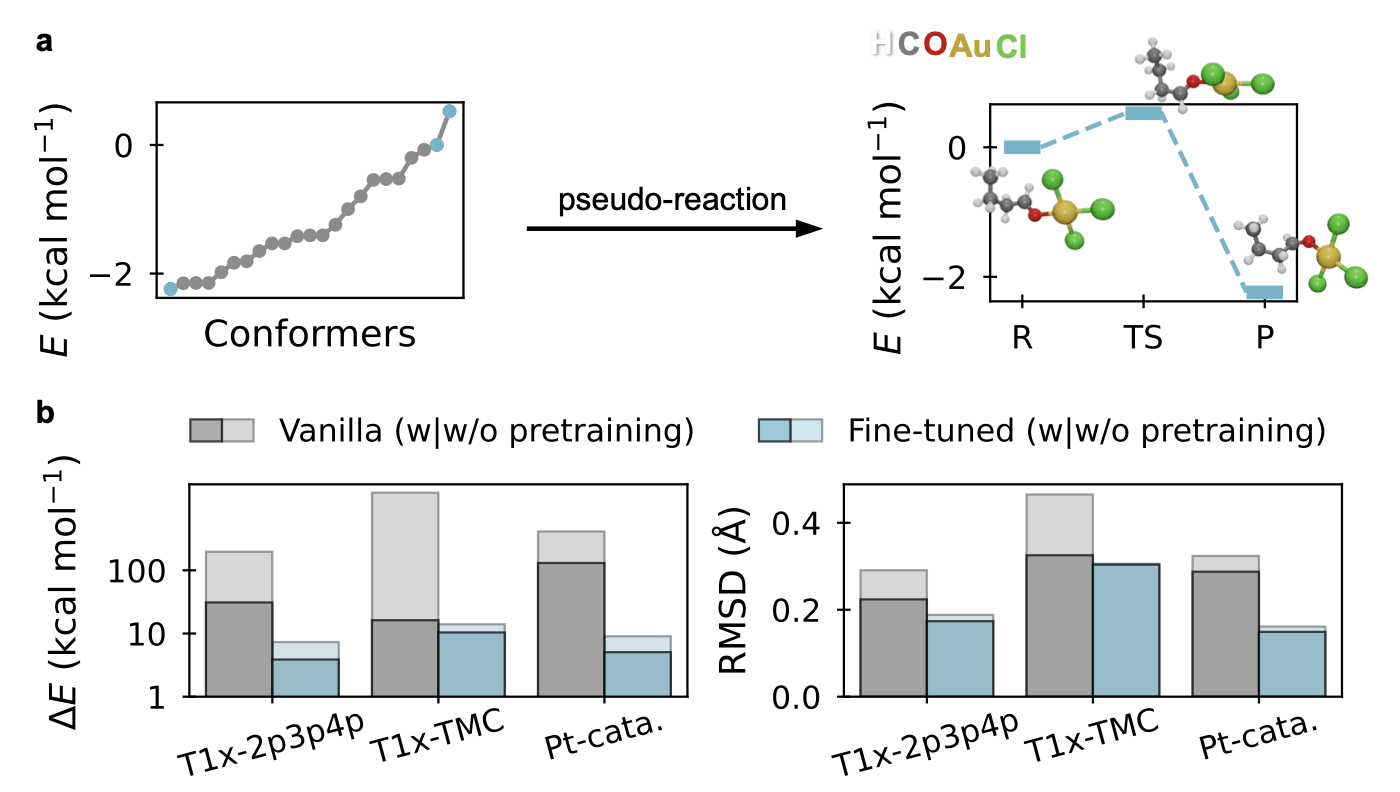
In a further effort to build deep learning architectures for the full periodic table, we introduced novel pretraining protocols for generative transition state models. We extended Transition1x by introducing element substitutions and transition metal complexes, and showed that state-of-the-art models collapse on even slightly out-of-distribution chemistry (Nature Comput Sci 2026). Critically, self-supervised pretraining on equilibrium conformers recovers the majority of performance without requiring high-quality fine-tuning data.
Relatedly, we fine-tuned large language models on organometallic SMILES to generate novel, structurally valid TMCs (ChemRxiv 2025), and recently introduced novel 3D-aware molecular fingerprints from spectral graph theory (arXiv 2026).
Advances in deep learning architectures and representations have enabled ML-driven chemical property prediction, but state-of-the-art (SOTA) models have remained largely confined to independent codebases and lack support for diverse chemical species. This work introduces ElemeNet, a unified, general-purpose software package for molecular machine learning. The ElemeNet software package enables the training of advanced ML models for diverse properties and datasets with an enlarged range of elemental compositions. We define molecular representations compatible with elements 1-100, supporting diverse organometallic and biological systems in addition to organic chemistry already well-served by the Chemprop ML toolkit. As well as more common atom-, bond-, and molecule-level predictions, we introduce moiety predictions. We also natively define optional conditioning on charge and spin states. Advanced E(3)-equivariant and transformer architectures are supported, as well as classical 2D models, with all classes including built-in uncertainty quantification through deterministic and statistical measures. We benchmark our protocols for ML model training against representative datasets from organic, inorganic, coordination, and biological chemistry, achieving competitive and SOTA performance relative to literature baselines and favorable scaling to millions of molecules. The entire workflow is exposed through a concise command-line interface, lowering the barrier to entry for non-expert users. We anticipate ElemeNet will empower non-computational researchers to leverage modern deep learning methods across the chemical and physical sciences.
@article{toney2026elemenet,title={ElemeNet: Multiscale Molecular Machine Learning with Uncertainty Quantification Across the Periodic Table},author={Toney, Jacob W. and Darouich, Samir and Wang, Yiran and Garrison, Aaron G. and Kästner, Johannes and Kulik, Heather J.},journal={arXiv},year={2026},publisher={arXiv},doi={10.48550/arXiv.2606.30961},url={https://doi.org/10.48550/arXiv.2606.30961},}
Transition states (TSs) govern the rates and outcomes of chemical reactions, making their accurate prediction a central challenge in computational chemistry. Although recent machine-learning models achieve near chemical accuracy in the prediction of TS structures and the associated reaction barriers for small organic reactions, their ability to generalize beyond the training domain remains largely unexplored. Here, we introduce targeted benchmarks to probe chemical and structural novelty in generative TS prediction. Building on Transition1x, a large-scale dataset of reactions involving small organic molecules, we construct curated extensions incorporating controlled elemental substitutions and diverse transition-metal complexes (TMC). These benchmarks reveal fundamental limitations of generative models in the generalization to previously unseen elements. As a result, they produce unphysical geometries and large energetic errors, even for reactions structurally similar to well-predicted organic systems. To address this challenge, we introduce a self-supervised pretraining strategy based on equilibrium conformers that exposes generative TS models to novel chemical environments prior to targeted fine-tuning. Across the newly proposed benchmarks, self-supervised pretraining substantially improves TS prediction for previously unseen systems, lowering the median RMSD of TS geometries on T1x-TMC reactions from 0.39 to 0.19 Å and reducing fine-tuning data requirements by up to 75%, enabling reliable performance even in low-data regimes. Overall, the integration of generative TS models with self-supervised pseudo-reaction pretraining provides an efficient, scalable, and chemically robust framework for elucidating TSs well beyond the small organic molecule domain, establishing a foundation for investigating complex and catalytically relevant reaction landscapes.
@article{darouich2026ncs,title={Robust Generative Transition State Models for Unseen Chemistry},author={Darouich, Samir and Toney, Jacob W. and Luo, Weiliang and Kästner, Johannes and Niepert, Mathias and Kulik, Heather J.},journal={Nature Computational Science},year={2026},publisher={Nature Portfolio},doi={10.1038/s43588-026-01034-5},url={https://doi.org/10.1038/s43588-026-01034-5}}
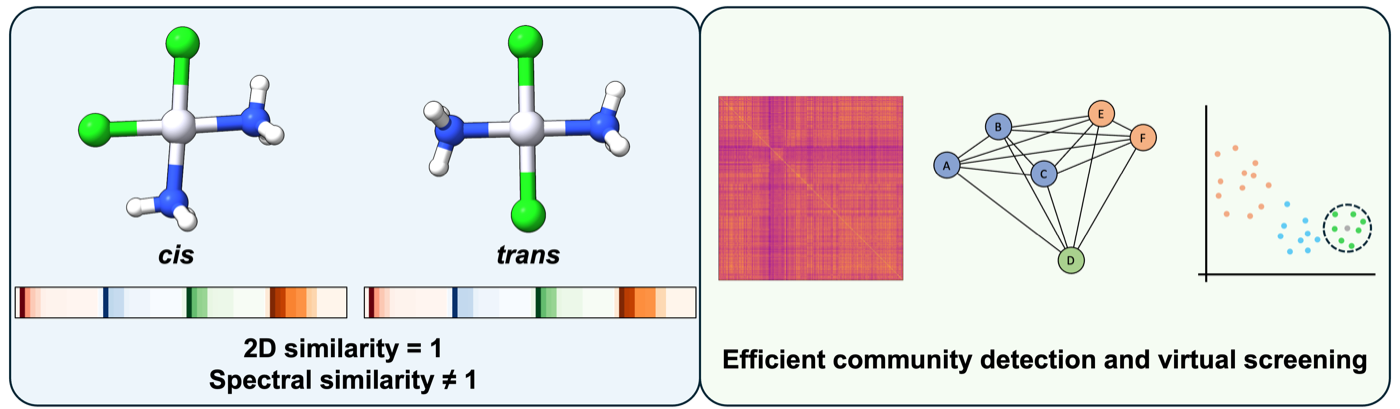
Molecular representations are essential for the evaluation of molecular similarity and the development of structure-property relationships. Despite the known importance of 3D structure to determine chemical and physical properties, the most widely used molecular fingerprints encode only two-dimensional connectivity. Such representations fail to distinguish similar but distinct stereoisomers and conformers. Alternative 3D methods are typically defined pairwise, making their application to large chemical spaces prohibitive, while deep learning embeddings are expressive but uninterpretable and limited by their training data diversity. Here, we introduce novel physics-inspired molecular fingerprints based on principles from spectral graph theory. We represent molecules as a complete graph in 3D space, with edge weights encoding heuristic physical interactions. Eigenvalue decomposition of the resulting graph Laplacian matrix results in a computationally efficient fixed-length chemical fingerprint that encodes 3D structure while obeying necessary physical symmetries of permutation and E(3) invariance. Spectral fingerprints differentiate between unique molecular structures with identical 2D connectivity, overcoming a limitation of 2D descriptors, while maintaining the low computational cost needed for efficient screening of vast chemical spaces. We evaluate our fingerprints with community detection algorithms and observe strong performance against representative baselines across datasets from organic, inorganic, biological, reticular, and reaction chemistry. Nearest-neighbor property estimation and applicability domain analyses reveal the utility of our molecular representation in machine learning and cheminformatics. We anticipate that spectral fingerprints will serve as generalizable, interpretable, and efficient measures of chemical similarity that incorporate 3D information at minimal cost.
@article{toney2026fingerprints,title={Physics-Based Molecular Fingerprints from Spectral Graph Theory Provide Efficient Geometry-Aware Measures of Chemical Similarity},author={Toney, Jacob W. and Farnood, Ayleen Y. and Darouich, Samir and Kulik, Heather J.},journal={arXiv},year={2026},publisher={arXiv},doi={10.48550/arXiv.2608.05336},url={https://doi.org/10.48550/arXiv.2608.05336}}
Exploring Transition Metal Complexes with Large Language Models
Yunsheng Liu, Jacob W. Toney, Joseph M. Cavanagh, Kunyang Sun, Andrew L. Smith, Chung-Yueh Yuan, Roland G. St. Michel, Paul A. Graggs, F. Dean Toste, Heather J. Kulik, and Teresa Head-Gordon
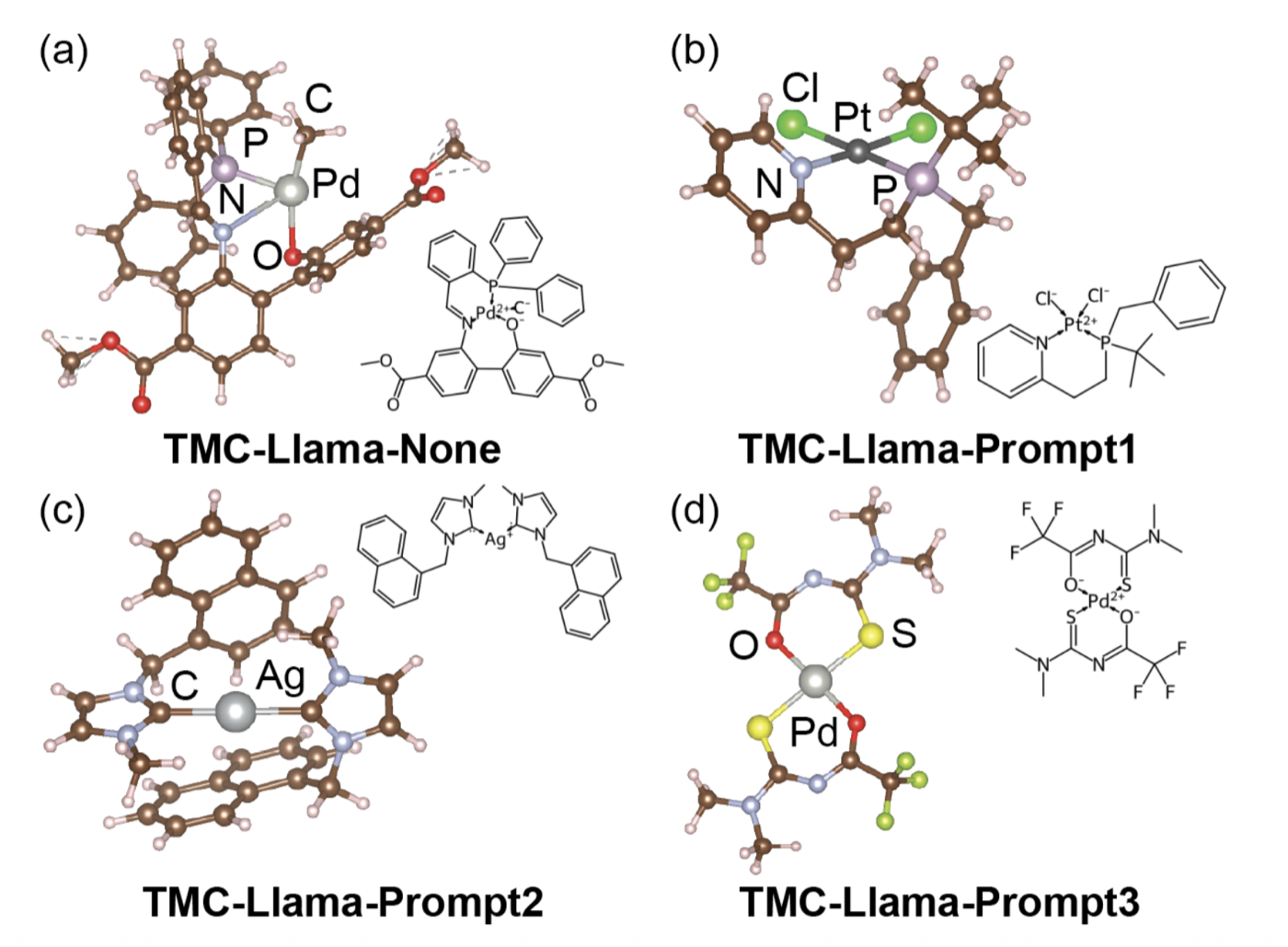
Here we use a large language model for the exploration of chemical space of transition metal complexes (TMCs), fine-tuning the open-source Llama-3.2-1B model with a variation of the SMILES string representation tailored for coordination chemistry. We identify several key molecular properties that are critical to produce valid TMCs which we use for prompt engineering, creating TMC-Llama models that generate unique, novel, and structurally validated TMCs at high success rates, and exceeding the performance of both standard benchmarks as well as state-of-the-art generative methods in the literature. We use the pydentate workflow to show that the TMC-Llama model generates new TMC chemistries that are physically realistic, synthetically plausible, and geometrically consistent with large datasets of known experimental TMCs. Our study lays the groundwork for future TMC-Llama generative model applications to discover new TMCs for functional materials for catalysis, photochemistry, medicine, and sustainability technologies.
@article{liu2025chemrxiv,title={Exploring Transition Metal Complexes with Large Language Models},author={Liu, Yunsheng and Toney, Jacob W. and Cavanagh, Joseph M. and Sun, Kunyang and Smith, Andrew L. and Yuan, Chung-Yueh and St. Michel, Roland G. and Graggs, Paul A. and Toste, F. Dean and Kulik, Heather J. and Head-Gordon, Teresa},journal={ChemRxiv},year={2025},publisher={ChemRxiv},doi={10.26434/chemrxiv-2025-hm3zb},url={https://doi.org/10.26434/chemrxiv-2025-hm3zb}}