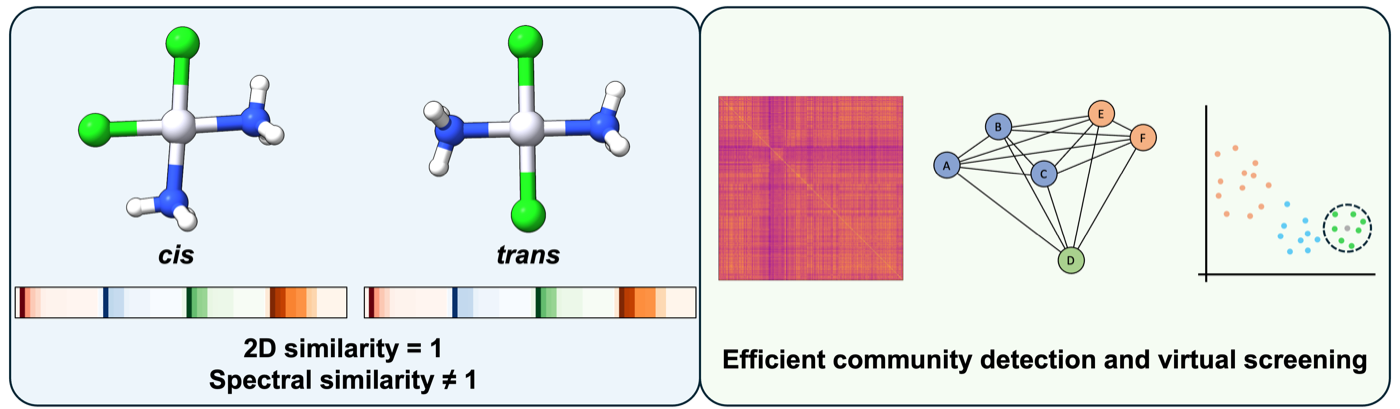
physics-based molecular representations that encode 3D structure with symmetry enforced by construction, at a fraction of the cost of learned models
Key to cheminformatics and computational chemistry is the notion of chemical similarity. Whether or not two molecules resemble one another is central to whether they are predicted to have similar properties, come from shared regions of chemical space, or are out-of-distribution to training data for machine learning models.
Classical chemical fingerprints rely on 2D connectivity to define vector representations of molecules. While these methods are fast and interpretable, they are blind to 3D effects such as stereochemistry and conformers, and generalize poorly to complex organometallic, biological, or distorted molecules. 3D methods based on shape overlap attempt to resolve this issue, but rely on pairwise alignment of atoms and are sensitive to atom ordering, limiting screening of large datasets. Learned representations meanwhile may capture geometry but require volumes of training data, sacrificing interpretability and generalizability.
Spectral graph theory offers a different path. We encode molecules as interaction tensors, where each channel consists of a matrix defined by pairwise physical interactions defined in Euclidean space. Calculating the eigenvalue spectrum produces a molecular fingerprint which is E(3) and permutation invariant. These fingerprints are inexpensive to compute, scale favorably, and have been integrated with community detection algorithms for the rapid and guided exploration of chemical space. Our recent work demonstrates the superior performance of spectral fingerprints relative to standard baselines across organic, inorganic, biological, and reticular chemistry (arXiv 2026). Their interpretability and efficiency make spectral fingerprints a promising new geometry-aware similarity measure, well-suited for cheminformatics and machine learning tasks.
Molecular representations are essential for the evaluation of molecular similarity and the development of structure-property relationships. Despite the known importance of 3D structure to determine chemical and physical properties, the most widely used molecular fingerprints encode only two-dimensional connectivity. Such representations fail to distinguish similar but distinct stereoisomers and conformers. Alternative 3D methods are typically defined pairwise, making their application to large chemical spaces prohibitive, while deep learning embeddings are expressive but uninterpretable and limited by their training data diversity. Here, we introduce novel physics-inspired molecular fingerprints based on principles from spectral graph theory. We represent molecules as a complete graph in 3D space, with edge weights encoding heuristic physical interactions. Eigenvalue decomposition of the resulting graph Laplacian matrix results in a computationally efficient fixed-length chemical fingerprint that encodes 3D structure while obeying necessary physical symmetries of permutation and E(3) invariance. Spectral fingerprints differentiate between unique molecular structures with identical 2D connectivity, overcoming a limitation of 2D descriptors, while maintaining the low computational cost needed for efficient screening of vast chemical spaces. We evaluate our fingerprints with community detection algorithms and observe strong performance against representative baselines across datasets from organic, inorganic, biological, reticular, and reaction chemistry. Nearest-neighbor property estimation and applicability domain analyses reveal the utility of our molecular representation in machine learning and cheminformatics. We anticipate that spectral fingerprints will serve as generalizable, interpretable, and efficient measures of chemical similarity that incorporate 3D information at minimal cost.
@article{toney2026fingerprints,title={Physics-Based Molecular Fingerprints from Spectral Graph Theory Provide Efficient Geometry-Aware Measures of Chemical Similarity},author={Toney, Jacob W. and Farnood, Ayleen Y. and Darouich, Samir and Kulik, Heather J.},journal={arXiv},year={2026},publisher={arXiv},doi={10.48550/arXiv.2608.05336},url={https://doi.org/10.48550/arXiv.2608.05336}}